
In the aftermath of crisis, adults often rush to reassure, respond and rebuild children’s lives. In Professor Ben Arieh’s experience the most striking insights into how Israeli children and young people have coped with trauma in the last two years have come from listening directly to children themselves.
Speaking at a March 2026 AUSiMED event co-hosted by Chabad Malvern, Professor Ben-Arieh (Dean of Social Work at Hebrew University of Jerusalem), shared two stories that reveal a powerful truth: Children’s perspectives on coping, support and resilience often differ sharply from adult assumptions.
In early December 2023, the Israeli education system decided that the high school children displaced from their communities (kibbutzim) in the Gaza envelope needed to go back to school in the city that they were evacuated to. The 12th graders refused to go. They insisted that they needed to stay together with their peers. They argued that their friendships, not structure, was what they needed to cope. Within three days, together with the help of some parents, a school was opened for them in Ein Gedi and they finished the school year together.
The second story came from Madj al Shams, a Druze town on Israel’s northern border where 12 children were killed in 2024 when a Hezbollah rocket struck a packed soccer field. The local council made plans to turn the site of the tragedy into a memorial. The children said they wanted something different: a space to play soccer, to remember their friends through joy rather than grief.
The Giving Voice to Children Project, an Australia-Israel research collaboration led by Professor Asher Ben-Arieh and Professor Sharon Goldfeld AM, Director of Population Studies at Murdoch Children’s Research Institute (MCRI) in Melbourne, is challenging current assumptions about how best to support children experiencing adversity and trauma.
At its core lies a simple but transformative idea: children are active interpreters of their own experiences, and their perspectives must be incorporated research, policy and professional practice.
Professor Goldfeld highlights that current approaches to trauma are largely based on adult concepts and may fail to align with children’s lived realities.
“We don’t have a good way of thinking about trauma with a child-centred view,” she explains. “We don’t understand how children understand coping, support and resilience and because of that, interventions may not meet children’s needs.”
The Giving Voice to Children project combines the MCRI teams’ expertise in child mental health and wellbeing and in meaningfully engaging children, with the Israeli teams’ expertise in child participation, early childhood trauma and research with Palestinian and Arab children.
The project goal is ambitious. They plan to build a child-informed framework for understanding how young people cope with adversity. A framework that reflects diverse cultural, social and familial contexts.
The research will involve using creative, narrative-based methods with children aged 6 to 12 in both countries, to explore questions such as:
- What helps you feel safe?
- What helps you move forward?
- What helps you stay strong?
Insights gathered from these conversations will inform a large-scale survey of 500 children, that will be used to design new child-informed tools, policies and professional training.
The Giving Voice to Children project is calling for a shift in mindset: A shift from doing thing to children to doing things with children.
By incorporating children’s own perspectives into trauma-informed frameworks and tools, the project will help reshape how health, welfare and education professionals support children’s mental health and wellbeing.
For more information about how to support the Giving Voice to Children project contact: Dr Karen Teshuva, AUSiMED Executive Director – karen@ausimed.org or CLICK HERE.
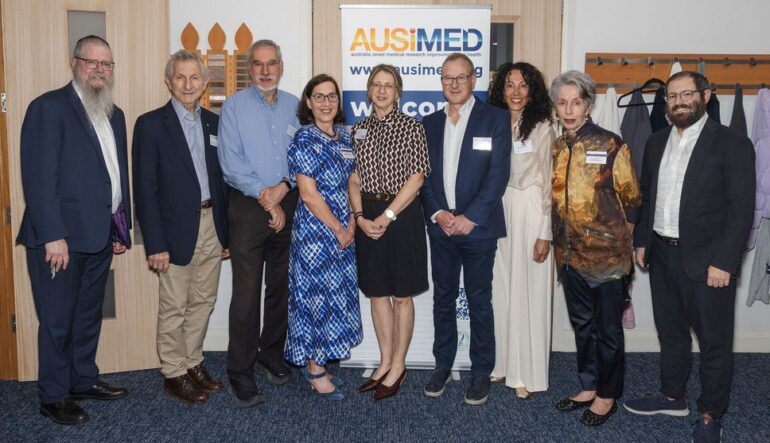
Pictured L-R: Rabbi S. Jurkowicz,Prof F. Oberklaid AM, Prof R. Coppel AO, Dr K. Teshuva, Prof S. Goldfeld AM, A. Cohen, D. Travers, S. Benjamin, Rabbi V. Slavin